---
slug: "bitrouter"
source_type: "readme"
source_url: "https://cdn.jsdelivr.net/gh/bitrouter/bitrouter@main/README.md"
repo: "https://github.com/bitrouter/bitrouter"
source_file: "README.md"
branch: "main"
---
# BitRouter
[](https://github.com/bitrouter/bitrouter/actions)
[](https://crates.io/crates/bitrouter)
[](LICENSE)
[](https://x.com/BitRouterAI)
[](https://discord.gg/G3zVrZDa5C)
[](https://huggingface.co/BitRouterAI)
[](https://bitrouter.ai)
[](https://www.linkedin.com/company/bitrouterai/?viewAsMember=true)
[](https://cal.com/kelsenliu)
**The self-improving LLM router that optimizes your agentic workflows with every run, works with any harnesses, any models, any loops.**
> **You're tokenmaxxing in production.**
> Every step of every loop bills at frontier prices — file reads, tool calls, sub-agent hops, retries. Most don't need it. BitRouter routes each call, tool, and agent to the cheapest path that still reaches the goal, and tightens that routing as the loop runs.
Cost is live today — latency and accuracy are next.
## Three primitives, one gateway
An agentic loop consumes three things. Other routers govern only the first. BitRouter makes all three routable, observable, and governed:
- **Models** — route LLM calls across providers, accounts, and wire protocols: OpenAI Chat Completions, OpenAI Responses, Anthropic Messages, and Google Gemini. *(the classic router, cross-protocol — any request format to any upstream, and back)*
- **Capabilities** — an **MCP gateway** and an **AgentSkills gateway**: tools and skills become governed, routable resources instead of hardcoded endpoints. *(The skills gateway folds into the MCP gateway once the [MCP skills extension](https://github.com/modelcontextprotocol/modelcontextprotocol/pull/2640) reaches production.)*
- **Agents** — an **ACP gateway**: sub-agents become first-class routable primitives, so a task can go to the sub-agent that best fits the loop's objective — just as a call routes to the best-fit model. *(Local sub-agents over stdio today; remote gateways arrive with [ACP v2](https://agentclientprotocol.com/rfds/v2/overview).)*
Optimizing a loop isn't just model selection — it's choosing the model, the tool, and the sub-agent that best serve the loop's objective at every step that gets it to its goal.
## The self-improving loop
BitRouter wraps your agentic loop in a second loop. Each loop gets its own **policy spec** — `bitrouter.yaml` — declaring how its calls, tools, and agents route. The routing key is **context-aware and lives as code**: it's the *step in the loop*, not just the model name — so "plan on the flagship, do routine file reads on something cheap" is one declarative table.
```yaml
# bitrouter.yaml — context-aware routing as code, keyed on the loop's step
policy_table:
tiers: # a tier name → the model it routes to
cheap: moonshotai/kimi-k2.6
flagship: gpt-5.5
fingerprints: # the agentic-loop step → which tier handles it
opening: flagship # first turn → plan on the strong model
after_read_file: cheap # routine file read → downgrade
midstream: cheap
default_tier: flagship # anything unmapped stays safe
tool_use_tier: flagship # guardrail: a tool call is never
tool_safe_tiers: [flagship] # stranded on a tool-blind model
adequacy:
enabled: true # a downgrade that starts failing…
escalation_tier: flagship # …escalates itself back up
```
Against that spec BitRouter runs a continuous **act → observe → evaluate → learn** cycle — and every step is a component it already ships:
- **Act — the router** reads the table and rewrites each call to its tier's model: policy-table routing, cross-protocol translation, multi-account failover.
- **Observe — telemetry** attributes every hop with cost, tokens, latency, and outcome, exported to Prometheus or any OTLP backend.
- **Evaluate — the eval engine** scores each routing decision against your objective: did the cheap route it picked still reach the goal?
- **Learn — the policy engine** folds that signal back into the spec. In-loop, `adequacy:` self-escalates a downgrade that starts failing; across runs the optimizer publishes an evolved, resolved `policy-lock.yaml` (an npm-style manifest/lock split, git-owned) — or you edit the table by hand.
You choose what the loop optimizes for — cost, latency, or accuracy — and the spec sharpens the longer it runs in production.
## Benchmarks
Today **cost** is the validated objective: on Terminal-Bench 2.1, `gpt-5.5` with BitRouter cut cost **32.8%** at near-parity accuracy (−1.1 pp), by offloading routine steps to a cheaper model. Latency and accuracy objectives — and more base models — are landing next.
| Base model | Cost vs baseline | Latency vs baseline | Accuracy vs baseline |
| --- | --- | --- | --- |
| `gpt-5.5` | **−32.8%**¹ | coming soon | coming soon |
| `gpt-5.6` | coming soon | coming soon | coming soon |
| `claude-opus-4.8` | coming soon | coming soon | coming soon |
| `claude-sonnet-5` | coming soon | coming soon | coming soon |
| `claude-fable-5` | coming soon | coming soon | coming soon |
¹ Cost-optimization run on Terminal-Bench 2.1: −32.8% zero-cache imputed cost (audited range 28.6–32.8% by cache share) at near-parity accuracy, −1.1 pp (76.1% vs 77.3%, within single-attempt noise).
This is a mechanism study under a modified protocol, not a Terminal-Bench leaderboard submission — read the [experiment limitations](https://github.com/bitrouter/bitrouter/blob/HEAD/benchmarks/001-2026-07-10-tbench-v2.1-codex-gpt55-kimi-k27.md#limitations) before citing the numbers. Full reports live in [`benchmarks/`](https://github.com/bitrouter/bitrouter/tree/HEAD/benchmarks/); complete traces, tool calls, usage, policy decisions, configs, and checksums are in the [`BitRouterAI/benchmarks`](https://huggingface.co/datasets/BitRouterAI/benchmarks) dataset.
## Comparison
Every gateway below routes model calls. BitRouter is the only one that also makes **tools and agents** routable, and optimizes the whole **loop** rather than a single call.
| | **BitRouter** | **OpenRouter** | **LiteLLM** | **TensorZero** | **Portkey** | **Bifrost** |
| --- | --- | --- | --- | --- | --- | --- |
| **Routable primitives** | Models + tools + **agents** (MCP + ACP) | Models | Models + tools (MCP) | Models | Models + tools (MCP) | Models + tools (MCP) |
| **Routing key** | **The loop step** (last tool called) | Model name | Model + request tags | Model name | Model + metadata | Model name |
| **Optimizes** | The **loop**, multi-objective (cost today) | Static routing | Static routing | The model | Static routing | Static routing |
_All but OpenRouter are open-source and self-hostable; BitRouter and TensorZero are Rust._
## What BitRouter is not
- **Not a static gateway** — it doesn't just forward calls to a fixed route; it runs an act → observe → evaluate → learn loop that keeps tightening the route as it runs. Every change it makes lands in a git-owned `policy-lock.yaml` you can read, diff, and revert — auto-tuning you fully own, never a black box.
- **Not an orchestration framework** — it doesn't define your agent's control flow, steps, or state; it routes the calls, tools, and sub-agents your loop already makes.
- **Not an agent harness** — it runs *under* Claude Code, Codex, and the rest, not instead of them.
## Install
```bash
# macOS / Linux
curl --proto '=https' --tlsv1.2 -LsSf https://github.com/bitrouter/bitrouter/releases/latest/download/bitrouter-installer.sh | sh
# Homebrew
brew install bitrouter/tap/bitrouter
# npm
npm install -g bitrouter
```
From source (Cargo)
```bash
cargo install bitrouter
```
## Quick Start
BitRouter is a local proxy between your agent and every LLM provider. One env-var swap — no harness changes required:
```diff
- OPENAI_BASE_URL=https://api.openai.com/v1 # hardwired to one provider, no fallback
+ OPENAI_BASE_URL=http://localhost:4356/v1 # all providers, automatic failover
```
### CLI
BitRouter runs as a local daemon — start it with your own keys or a Cloud sign-in.
**Bring your own keys (BYOK)** — auto-detected from the environment, no config file needed:
```bash
export OPENAI_API_KEY=sk-... # ANTHROPIC_API_KEY / GEMINI_API_KEY also work
bitrouter start # proxy running at http://localhost:4356
```
**Or sign in to BitRouter Cloud** — use browser OAuth interactively or store an existing API key in CI:
```bash
bitrouter cloud login # RFC 8628 device flow against api.bitrouter.ai
bitrouter cloud login --api-key "$BITROUTER_API_KEY" # non-interactive CI login
bitrouter start # `bitrouter` provider auto-enables once signed in
```
The same credential also drives a [`gh api`](https://cli.github.com/manual/gh_api)-style raw client—no daemon required:
```bash
bitrouter cloud api /v1/models
bitrouter cloud api /v1/chat/completions --input request.json
```
Point your agent runtime at `http://localhost:4356` and any available provider is live. For advanced routing rules, guardrails, or multi-account failover, scaffold a config with `bitrouter init` (writes `./bitrouter.yaml`).
```bash
bitrouter start / stop / restart # daemon lifecycle
bitrouter route # trace how a model name resolves
bitrouter key sign --user # mint a scoped brvk_ API key
bitrouter cloud keys / usage / billing # manage your cloud account
bitrouter cloud api /v1/models # call Cloud APIs directly
```
See [`docs/CLI.md`](https://github.com/bitrouter/bitrouter/blob/HEAD/docs/CLI.md) for the full command reference, flags, and config resolution.
### Agent Skill
BitRouter ships an [Agent Skill](https://agentskills.io) — `/bitrouter` — so AI
coding agents can install, configure, migrate to, and troubleshoot BitRouter on
their own. It lives in this repo at [`skills/bitrouter/`](https://github.com/bitrouter/bitrouter/tree/HEAD/skills/bitrouter/), kept in sync
with the code.
```bash
bitrouter skills add bitrouter # via BitRouter's own installer
npx skills add bitrouter/bitrouter # via the generic skills CLI
```
### MCP
Use BitRouter from any MCP client — it exposes `complete`, `list_models`, and `status` as MCP tools (the *origin* server, distinct from the MCP gateway that proxies your own MCP servers):
```bash
bitrouter mcp serve # stdio → local daemon at 127.0.0.1:4356
bitrouter mcp install --client claude # print the Claude/Cursor mcpServers config block
```
Add `--transport http` to target the multi-tenant cloud backend.
### API
BitRouter exposes an OpenAI- and Anthropic-compatible HTTP API on `http://localhost:4356`, so any SDK or client works unchanged. The full endpoint reference and OpenAPI spec live in [`bitrouter/bitrouter-docs`](https://github.com/bitrouter/bitrouter-docs) (rendered at [bitrouter.ai](https://bitrouter.ai)).
## Workflow templates
Ready-made **policy specs** for common agentic workflows — a starting point that routes well out of the box, before you tune it for your own loop. **Coming soon** in [`templates/`](https://github.com/bitrouter/bitrouter/tree/HEAD/templates/).
## Models & providers
BitRouter routes to a *model*, not a provider. Each family below is served by many providers — its own lab, hyperscalers (AWS Bedrock, Alibaba Cloud), gateways (OpenRouter, OpenCode), and serverless clouds — and BitRouter picks the cheapest route per call. **Bring your own key** to any of them, or use one **BitRouter Cloud** account with no keys at all.
| Lab | Latest models |
| -------- | -------------------------------- |
| DeepSeek | DeepSeek V4 Pro / Flash |
| Alibaba | Qwen3.7 Max / Plus |
| Moonshot | Kimi K2.7 Code / K2.6 |
| Z.ai | GLM-5.2 / 5.1 |
| MiniMax | MiniMax M3 / M2.7 |
| Xiaomi | MiMo V2.5 Pro / V2.5 |
| StepFun | Step 3.7 Flash / 3.5 Flash |
Plus every frontier model from OpenAI, Anthropic, Google, and xAI — over your own keys, a subscription sign-in (Claude Pro/Max, GitHub Copilot, ChatGPT Codex), or BitRouter Cloud. Full catalog in the [registry/](https://github.com/bitrouter/bitrouter/tree/HEAD/registry/).
## Harness integrations
Any agent runtime that speaks OpenAI or Anthropic APIs works with BitRouter out of the box — set `OPENAI_BASE_URL=http://localhost:4356/v1` and you're done. The following harnesses are tested and supported:
| Harness | Status | Notes |
| -------------- | ------ | ------------------------------------------------------------------------------------------- |
| Claude Code | ✅ | [LLM gateway guide](https://code.claude.com/docs/en/llm-gateway) |
| OpenAI Codex | ✅ | `bitrouter launch --agent codex` or [custom model providers](https://developers.openai.com/codex/config-advanced#custom-model-providers) |
| OpenCode | ✅ | Via [models.dev](https://github.com/anomalyco/models.dev) |
| Hermes Agent | ✅ | Native plugin — [hermes-bitrouter-plugin](https://github.com/bitrouter/hermes-bitrouter-plugin) |
| OpenClaw | ✅ | Native plugin — [bitrouter-openclaw](https://github.com/bitrouter/bitrouter-openclaw) |
| Pi-Agent | ✅ | [Model configuration guide](https://github.com/earendil-works/pi/blob/main/packages/coding-agent/docs/models.md) |
The full provider and harness catalog lives in [github.com/bitrouter/bitrouter/registry](https://github.com/bitrouter/bitrouter/tree/main/registry).
## Features
Beyond the gateways above, the production controls for running agents unattended:
- **Multi-account failover + load-balancing** — reroute mid-run; a rate-limit at file 140 never re-pays for files 1–139
- **Virtual keys (`brvk_`)** scoped per agent or user — no agent holds an upstream key
- **Per-agent spend caps + loop guards** to contain runaway cost
- **Injection + output guardrails** at the router, before requests leave your network
- **Zero-config auto-detection** + custom OpenAI-/Anthropic-compatible providers
## Talk to founders
**[Try BitRouter Cloud →](https://cloud.bitrouter.ai)** or reach out directly:
Want a first-party provider integration, or building an open-source agent/harness? Email [kelsenliu@bitrouter.ai](mailto:kelsenliu@bitrouter.ai) or [book a meeting](https://cal.com/kelsenliu) — open-source builders get **up to 50% off** for you and your community.
## Development
- [`docs/DEVELOPMENT.md`](https://github.com/bitrouter/bitrouter/blob/HEAD/docs/DEVELOPMENT.md) — workspace architecture and SDK internals
- [`CONTRIBUTING.md`](https://github.com/bitrouter/bitrouter/blob/HEAD/CONTRIBUTING.md) — contribution workflow, issue reporting, and provider updates
- [`CLAUDE.md`](https://github.com/bitrouter/bitrouter/blob/HEAD/CLAUDE.md) — guidance for AI coding agents working in this repository
- [`skills/`](https://github.com/bitrouter/bitrouter/tree/HEAD/skills/) — the `/bitrouter` Agent Skill (source of truth)
## Star History
[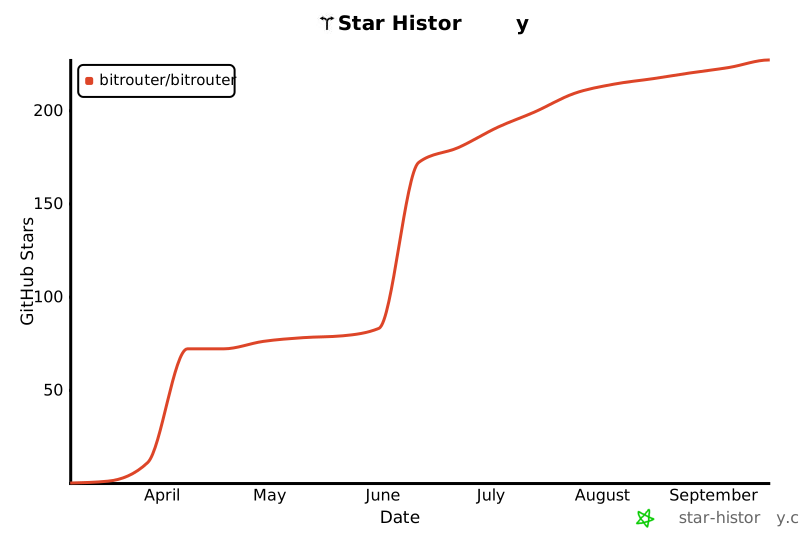](https://star-history.com/#bitrouter/bitrouter&Date)
## License
Licensed under the [Apache License 2.0](https://github.com/bitrouter/bitrouter/tree/HEAD/LICENSE).