---
slug: "idea-to-ship-skills"
source_type: "readme"
source_url: "https://cdn.jsdelivr.net/gh/nelsonwerd/idea-to-ship-skills@main/README.md"
repo: "https://github.com/nelsonwerd/idea-to-ship-skills"
source_file: "README.md"
branch: "main"
---
# idea-to-ship
**Composable Agent Skills — for Claude and OpenAI Codex — that take an idea from *fuzzy* → *validated* → *sequenced build* → *shipped*: by hand, or on autopilot.**
Most "build with AI" workflows skip the hard half. They jump straight to code — and skip *deciding what's actually worth building*, *validating it honestly*, and *planning the build so it ships in safe, verifiable steps*. `idea-to-ship` is that missing front half — plus the autonomous build loop on the far side of it: a small, sharp suite of Agent Skills (they run in **Claude** and **OpenAI Codex**), reverse-engineered from real idea→ship journeys (including the mistakes those journeys made), so you don't repeat them.

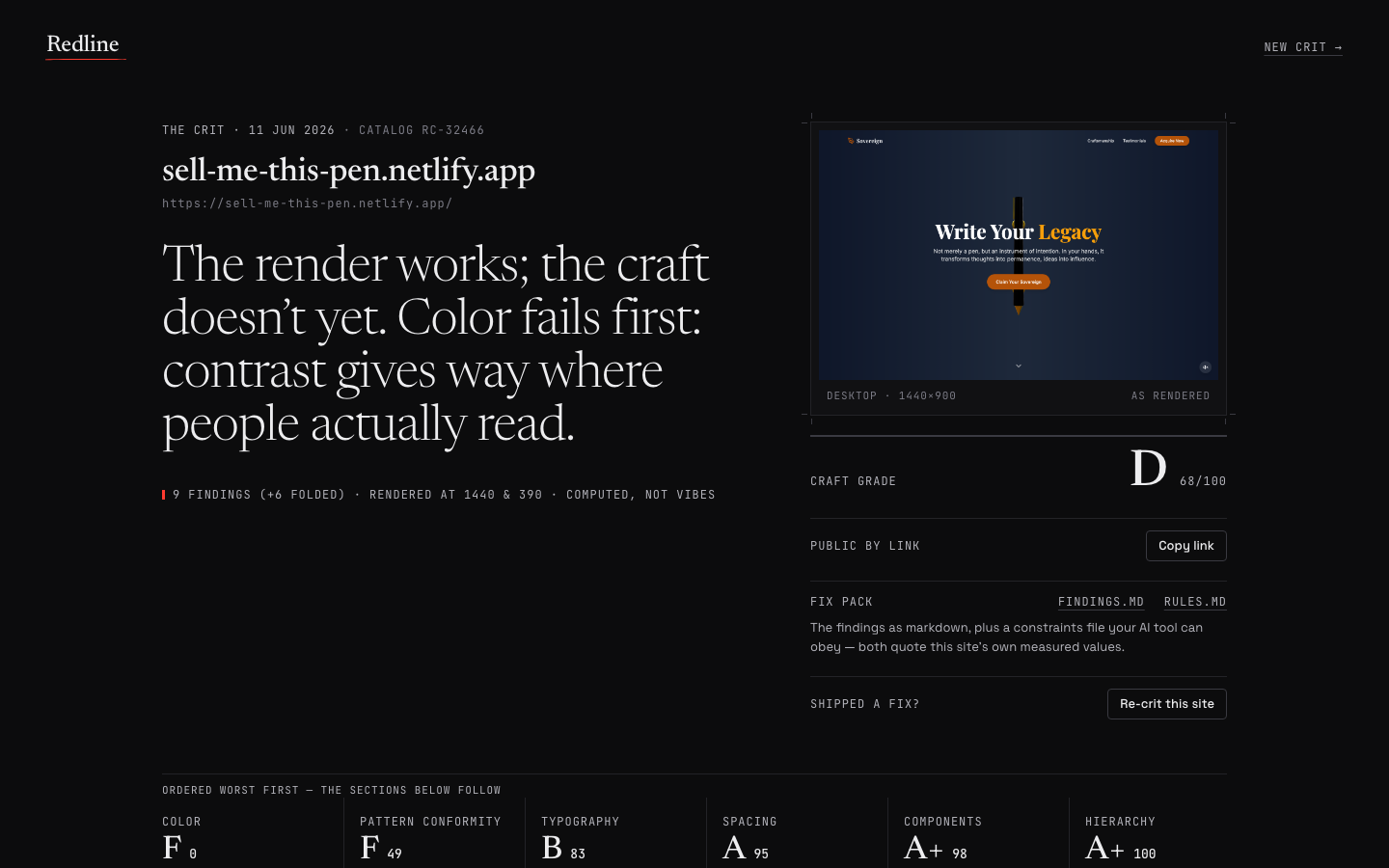
Real output: a crit page from Redline, built unattended by autopilot in one 13.5-hour overnight run. See the case study, including where it failed.
They're **separate, composable** skills on purpose — sharp triggers, lean context, independent use. Run them **by hand** (the manual tier), or let **`autopilot`** fly the whole line for you (the autonomous tier).
**Who it's for.** Solo and small-team builders who tend to start coding before deciding *what's actually worth building* — working in **Claude** or **OpenAI Codex**. If you've shipped a feature nobody used, rebuilt something and lost the parts that worked, or watched a big change stall halfway, this suite front-loads the discipline that prevents it. Each skill also earns its keep alone. (`deep-dive` is token-hungry by design — see its note below; it shines most when you're not token-constrained, e.g. on a Claude Max plan.)
## The pipeline
1. **`ideate`** — turn a fuzzy idea (or an existing thing you want to improve) into a *locked* concept + roadmap, captured in one living `CONCEPT_BRIEF.md`. A blunt, honest co-founder: it forces a success metric and a kill criterion, refuses to spec before the concept survives an honest pressure-test, and hands off cleanly to `prompt-pack`.
2. **`deep-dive`** — the rigor engine `ideate` leans on for high-stakes validation (and that you can run directly on any codebase, strategy, design, or research question): parallel specialist agents → synthesis → adversarial red-team → a plain-English verdict with honest 1–10 confidence.
3. **`prompt-pack`** — turn a settled concept into a sequence of self-contained, independently-shippable build prompts: each does one unit, verifies itself, and leaves the app working before the next. Run them in one chat or spread across many — each prompt is self-contained, so any unit moves cleanly to a fresh chat whenever you want (or need) one. Also writes paste-ready handoffs to resume a chat or relay work to another tool.
4. **`build-loop`** — drive a build past *"it compiles"* to **near-finish-line craft**: it *sees and exercises* the running app — render → screenshot → critique → rebuild, multi-pass — and checks the machine facts (build, tests, flows, console, a11y) until acceptance criteria pass or a stop-condition fires (no infinite thrash). When feel is load-bearing the visual design loop runs every iteration. Honest bound: objective craft + a self-graded taste pass, ~80% of the way — not a finished or validated product.
→ **drive each step yourself**, or let **`autopilot`** fly the whole line autonomously — in character as a grounded founder-persona — handing back a near-finish-line *first draft* plus an honest ledger of what only a human or the market can finish.
→ Already have a codebase? **`audit-and-fix`** points the same autonomy backwards: **audit → triage → fix**, skipping ideation entirely (your code *is* the grounding) and stopping at verified local commits. It's also the natural **second pass on an `autopilot` run** — autopilot hands back a first draft with a known correctness/security tail, and that tail is exactly what `audit-and-fix` is built to attack. (It doesn't close the *taste* or *market* half of that tail; those stay human.)
## Quickstart — try one first
| If you want to… | Type this | You get back |
|---|---|---|
| Decide *what* to build | "I have an idea for *X* — help me decide if it's worth building." | `docs/CONCEPT_BRIEF.md` |
| Investigate something rigorously | "Do a standard design evaluation of *X*. Research-only." | `research//` + an executive briefing |
| Turn settled scope into a build plan | "Make a prompt pack from `docs/CONCEPT_BRIEF.md`." (or "*X* is too big for one chat — make me a prompt pack.") | `docs/_PROMPT_PACK.md` |
| Drive a build to near-finish-line craft | "Loop on this until the core flows pass and the UI holds its design bar." | a self-verified, iterated build + an honest craft ledger |
| Fly the whole pipeline autonomously | "Run autopilot on *X*." | a `CONCEPT_BRIEF`, a build pack, a first-draft app + an honest hand-off |
| Audit a repo *and fix what's found* | "Audit this repo and fix what you find." | an audit + a triage verdict → verified local commits + an honest ledger |
Each works standalone; run them in sequence — or on autopilot — for the full idea→ship pipeline.
See what you actually get back — a worked example (click to expand)
**`ideate` → `docs/CONCEPT_BRIEF.md`** *(excerpt — the locked concept + honest verdict, edited in place across the session, not regenerated):*
> - **Confidence verdict:** 7/10 — would move to 8 if 5 target users confirm the triage pain in interviews; down to 4 if they already tolerate shared Gmail.
> - **One-line promise:** Every client message handled by the right person, fast — without anyone owning a chaotic shared inbox.
> - **Beachhead persona:** 2–6 person creative/client-service studios. *(Secondary: solo freelancers — not v1.)*
> - **Success metric:** % of client messages with a clear owner + reply within 1 business day.
> - **Kill criterion:** If 5 target studios won't try a 2-week pilot, shelve it.
> - **Scope OUT / deferred:** Outlook, analytics dashboard, mobile app — each named with a one-line reason.
> - LOCKED: Layer on existing email, don't replace it — lowers switching cost (the wedge).
**`deep-dive` → `research//NN-executive-briefing.md`** *(excerpt — verdict-first, after parallel specialists + an adversarial red-team):*
> **TL;DR.** Sound core; one blocker before you ship. **Confidence: 6/10 — 4 of 7 load-bearing findings externally verified (tests + `git`); the rest rest on model judgment.**
> - **[Blocker]** Currency rounding diverges between server and client — `pricing.ts:142` vs `format.ts:88`.
> - **[High]** No regression test covers the refund path; a silent change there ships unnoticed.
> - **Should you proceed?** Fix the blocker, add the refund test, then ship Phase 1.
**`prompt-pack` → `docs/_PROMPT_PACK.md`** *(excerpt — one self-contained, independently-shippable unit; reads the brief above):*
> **P2 · Add per-currency rounding — Risk: HIGH**
> **Read first:** `CLAUDE.md`, `docs/CONCEPT_BRIEF.md`, `pricing.ts` — *verify file:line before editing.*
> **What MUST NOT change:** the public `formatAmount()` signature; existing USD output.
> **Verification:** `npm test pricing` + manual matrix (regression: USD unchanged · new: JPY 0-decimal, BHD 3-decimal).
> **When done:** report files changed + test results. **Do not commit — wait for explicit go.**
## The skills
**Manual tier — drive each step yourself.**
### 🧭 ideate — *find & validate what to build*
Fuzzy idea → locked concept + roadmap. Two modes: **greenfield** (a new idea) and **refinement** (evaluate/improve an existing thing). Triggers: *"help me figure out what to build"*, *"is this idea any good"*, *"should I rebuild X"*, *"turn my idea into a plan"*. → [ideate-skill](https://github.com/nelsonwerd/ideate-skill)
### 🔬 deep-dive — *investigate it rigorously*
Multi-agent investigative analysis for questions that deserve more than a one-shot answer: audits, strategy/viability evaluations, design reviews, open research. Triggers: *"do a deep dive"*, *"thorough audit"*, *"evaluate this strategy"*, *"is this sound/safe"*. → [deep-dive-skill](https://github.com/nelsonwerd/deep-dive-skill)
> **Note — `deep-dive` is token-hungry by design.** A full run fans out 4–6 specialist agents (each writing thousands of words), then synthesis, follow-up verification, a red-team pass, and a briefing — easily 10+ agent calls and tens of thousands of tokens for one analysis. That's the right trade for a high-stakes call, and a great fit on a **Claude Max** plan (or any setup where you're not token-constrained). On a smaller plan, reach for it deliberately: lean on its built-in *Scale heuristics* (2–3 lanes for narrow scope, skip the red-team for low-stakes work), or ask for a single-pass review instead. `ideate` and `prompt-pack` are far lighter.
### 📦 prompt-pack — *turn it into a shippable plan*
A big job → ordered, self-contained prompts, each shippable on its own, plus handoffs. Run them in one chat or across many. Triggers: *"make a prompt pack"*, *"break this into phases"*, *"I'm running out of context"*, *"write me a handoff"*. → [prompt-pack-skill](https://github.com/nelsonwerd/prompt-pack-skill)
**Autonomous tier — the pipeline drives itself.**
> **Experimental — and honest about why.** The autonomous tier is an early, lightly-proven experiment: genuinely capable and a lot of fun to watch, but not battle-tested — treat it as a promising prototype, not a production tool. It produces a near-finish-line-*aimed* **first draft a human finishes** — not a finished or market-validated product. Three limits it doesn't escape: a **~80% craft ceiling** with a last-mile correctness/security/taste tail; the **grounding firewall** (real data may discover the problem and seed the build, but a synthetic persona's reaction never counts as validation); and judgment quality isn't cleanly measurable — its go/kill calls are a **signal a human weighs**, never proof. Market validation stays the human handoff. We stress-tested it on a heavy overnight run; [the case study](https://github.com/nelsonwerd/idea-to-ship-skills/blob/HEAD/docs/CASE_STUDY_REDLINE.md) shows exactly what came back, including where it failed.
>
> **And it's token-heavy.** A single `autopilot` run drives the whole pipeline — a `deep-dive`, a multi-pass visual loop, a different-model critic — so it can span hours and a lot of tokens (measured on one heavy run: ~24.1M fresh tokens, ~784M processed of which 97% were prompt-cache reads; see the case study). Best on a **bigger plan (e.g. Claude Max)** or any setup where you're not token-constrained; on a smaller plan, reach for the manual-tier skills directly, or scope the run tight.
### 🚀 autopilot — *fly the whole pipeline autonomously*
Runs **ideate → deep-dive → prompt-pack → build-loop** end-to-end, in character as a *grounded* founder-persona — **composing** the manual-tier skills, never reimplementing them. Hands back a `CONCEPT_BRIEF`, a validated build pack, a first-draft product, and an honest ledger of what only a human/market can finish. Carries **execute-discipline** (build only the gated scope; emit a human-only gate, never fake it). Stress-tested on a 13.5-hour unattended run → [the case study](https://github.com/nelsonwerd/idea-to-ship-skills/blob/HEAD/docs/CASE_STUDY_REDLINE.md). Triggers: *"run autopilot"*, *"build this idea→ship autonomously"*, *"fly the whole pipeline end to end"*. *Suite-only — no standalone repo.*
### 🔁 build-loop — *drive a build to near-finish-line craft*
Loops **build → see → exercise → check → critique → rebuild** over the agent's existing tools (headless screenshot + vision to *see*, Playwright to *exercise*, axe/Lighthouse to *check*) until acceptance criteria pass or a stop-condition fires — no infinite thrash. When feel is load-bearing it runs a **mandatory, multi-pass visual design loop** (render → critique → fix → re-render, every iteration) with a different-model critic as the taste check. Honest bound: it flags *ugly/broken/missing* reliably but stays self-graded on *genuinely good* → a **human spot-check is the final taste gate**; market validation is out of scope. Triggers: *"tighten this build"*, *"iterate until it passes"*, *"self-verify the UI"*. *Suite-only — no standalone repo.*
### 🔧 audit-and-fix — *audit an existing repo, then fix what's worth fixing*
Runs **deep-dive → triage → prompt-pack → build-loop** on a codebase you already have — **composing** the manual-tier skills, never reimplementing them. `autopilot` builds something that doesn't exist and risks *inventing demand*; `audit-and-fix` repairs something that does and risks *breaking working software*. **Ideation is dropped entirely — your codebase replaces it as the source of truth.** Its signature move is the **triage verdict**: not "here are 30 findings," but *what's worth fixing given where you're headed* — an opinion, not a menu. Then **one gate**, and it runs to completion unattended: sequenced units, a red-first regression test per fix, verification receipts, one commit per verified unit. Honest bounds: **a receipt records what ran, it never proves correctness**; it only fixes what the audit found; the live/real-world tail (real accounts, the first CI run) is **never** cleared; and it stops at **local commits — never pushes, merges, tags, or publishes.** Triggers: *"audit this repo and fix what you find"*, *"audit and edit"*, *"deep dive then fix the bugs"*, *"autopilot this repo but skip the ideation"*. *Suite-only — no standalone repo.*
*An optional `ground` module — real data to seed the persona and the build — is planned; the autonomous tier runs fully without it, and the firewall holds either way.*
## Case study: a 13.5-hour autonomous run
I pointed `autopilot` at the heaviest mandate I could write (find your own grounded niche, build a real frontend and backend, hold a serious design bar, don't stop to ask) and went to bed. It ran unattended overnight and came back with **Redline**: a working design-crit engine for AI-built frontends. Paste a URL, a deterministic render-and-measure pipeline crits the page like a designer would, with typed findings and visual evidence.
The numbers below were re-verified from git, the session transcripts, and a cold re-run of the test wall in an isolated copy. Not self-reports.
- **13.5 hours** wall clock, **22 commits**, 16/16 prompt-pack units passed, zero human interventions
- **~27,000 lines** of TypeScript; **387 unit tests + 92 e2e**, all reproduced green
- 47 build/critic passes, a 13-agent deep-dive, 372 screenshots kept as evidence
- **~24.1M fresh tokens** (~784M processed, 97% of that prompt-cache reads). Plan accordingly.
- **7 human gates emitted and left open**, none faked: API keys, deploy sign-off, taste review, market validation
And the half that makes this worth reading: the product thesis is **unproven** (the engine was calibrated and validated on the same 24 sites), and the build shipped with a **known, documented, unfixed SSRF vulnerability** parked behind a do-not-deploy checklist it could not clear itself. That is the ~80% ceiling, with receipts.
- The write-up (exact kickoff prompt, verified numbers, where it failed): **[docs/CASE_STUDY_REDLINE.md](https://github.com/nelsonwerd/idea-to-ship-skills/blob/HEAD/docs/CASE_STUDY_REDLINE.md)**
- The artifact itself (full 22-commit history, ledgers, gates, the debrief): **[redline-autopilot-case-study](https://github.com/nelsonwerd/redline-autopilot-case-study)**
> The built product must **not** be deployed publicly as-is. Details and disclaimers in the case study.
## Also built with it
Redline is the *stress test* — one heavy ask, on purpose. These are the ordinary use: real tools I needed, built with the suite and public, so the claims here have something to check.
- **[wake](https://github.com/nelsonwerd/wake)** — a fleet supervisor for coding agents. More useful here as **provenance than as a product**: the `audit→fix` runs this repo distills were run *on wake*, so the failures in `audit-and-fix`'s rules table — the non-reproduction that turned out to be luck, the "zero adapter changes" plan that was wrong, the stray binary that staled a receipt — happened in that git history. Every rule was paid for; that's where the receipts are.
- **[didrun](https://github.com/nelsonwerd/didrun)** — the evidence recorder `audit-and-fix` leans on: it records what actually ran (argv, real exit code, tree state) and grades claims against a sealed commit. It's a **first-draft tool, dogfooded** — the skill's own reference file lists the bugs these runs found in it. The skill needs *a* receipt tool, not *this* one; the discipline is portable, the tool is mine.
> **Read the honest version of that claim.** These were built with the **method** `audit-and-fix` distills — not the skill, which postdates them by months. That distinction is load-bearing: the skill's own bounds say its `build-loop`-per-unit seam **has never actually run**. So wake is evidence the *audit→fix method* works and that its rules were earned — it is **not** evidence the skill is proven. Nothing here has been through it end-to-end yet.
## How they compose
- `ideate` produces a **`CONCEPT_BRIEF.md`** — the single artifact `prompt-pack` consumes to author build prompts. (ideate delivers the *what & why*; prompt-pack derives the *how* from your actual code.)
- `ideate` **delegates to `deep-dive`** when a concept needs heavy, current-sourced validation, and folds the verdict back into the brief.
- `build-loop` drives any build — from a `prompt-pack` step or on its own — toward near-finish-line craft; it's the craft engine the autonomous tier leans on.
- `autopilot` **composes all four** (ideate → deep-dive → prompt-pack → build-loop) to fly the whole pipeline autonomously — orchestration only, never reimplementing them.
- `audit-and-fix` **composes three of them** (deep-dive → prompt-pack → build-loop) in the other direction: `deep-dive` *generates* the work instead of validating a brief, and its **Tier 0/1/2/3 fix list — already sized for one work session each — becomes `prompt-pack`'s units** directly. The two orchestrators share a tier and a discipline, but never each other's risks — **and they chain**: `autopilot` → `audit-and-fix` is the common second pass, aimed at the correctness/security tail autopilot's ~80% ceiling leaves behind.
- Each is also fully useful **on its own** — run `deep-dive` to audit a codebase, `prompt-pack` to sequence a refactor, `ideate` to gut-check an idea, `build-loop` to tighten a build — without the others.
**Which skill for which question?** (they overlap on "evaluate / plan" — here's the precedence)
| The user is really asking… | Skill | Then |
|---|---|---|
| *What should I build? Is this idea worth pursuing?* | **ideate** | locks a `CONCEPT_BRIEF.md`; delegates heavy validation to `deep-dive` mid-funnel |
| *Is this correct / safe / viable / evidence-backed?* | **deep-dive** | returns a verdict + confidence; if it was validating a concept, hands a block back to `ideate` |
| *Scope is settled — sequence the build* | **prompt-pack** | reads `CONCEPT_BRIEF.md` if present; offers `ideate` first if the idea is unsettled |
| *Does this build actually work + hold a craft bar?* | **build-loop** | loops see/exercise/critique until it passes or a stop-condition fires |
| *Build the whole thing for me, autonomously* | **autopilot** | flies ideate→…→build-loop in-character; hands back a first draft + an honest ledger |
| *Audit my repo **and fix** what you find* | **audit-and-fix** | audits read-only, triages against your next goal, takes one go, then fixes to verified local commits |
| *Genuinely unclear* | ask one question | *viability direction, rigorous audit, execution-planning, or autonomous build?* |
**deep-dive vs. audit-and-fix** — they overlap on *"audit this codebase"*, so: `deep-dive` answers *"is it sound?"* **and stops.** `audit-and-fix` answers *"is it sound, what's worth fixing given where you're headed — now go fix it."* **No intent to change the code → `deep-dive`** (it's also far cheaper).
These compose, but each also runs alone — install only the one you need.
## Install
These follow the open **[Agent Skills](https://agentskills.io) standard**, so they run in **Claude** and **OpenAI Codex** — install them all as a **Claude Code plugin**, drop them into your **Codex skills folder**, or copy individual skills anywhere. Pick your setup:
| You use… | Get them all by… |
|---|---|
| **Claude Code** — terminal, the **Code** tab of the Claude desktop app, [claude.ai/code](https://claude.ai/code), or a VS Code / JetBrains IDE | the **plugin** (Option 1), or a manual copy (Option 2) |
| **OpenAI Codex** — CLI, app, or IDE | copying the skills into `~/.agents/skills/` (Option 2) |
| **Claude chat** — the **Chat** tab of the desktop app, or [claude.ai](https://claude.ai) (non-coding use) | uploading each skill's **`.skill`** zip (in this repo root) under **Customize → Skills**. Best for `ideate`; the others want repo/file access (and `build-loop`/`autopilot` want the build tools too). |
| **Any other agent** | pointing it at any `skills//SKILL.md` — it's just instructions |
**"Claude Code" and "Claude chat" both live in the one Claude desktop app** — its **Code** tab vs its **Chat** tab (plus their terminal / web / IDE surfaces). Plugins install in Claude Code only; the Chat tab takes uploaded skills under *Customize → Skills*.
### Compatibility by skill × surface
The skill *format* is portable; some *runtime* features (parallel subagents, progress tools, web/repo access, a headless browser) are richest in Claude Code and Codex. Each skill still runs everywhere — degraded cells lose mechanics, not method.
| Skill | Claude chat | Claude Code | OpenAI Codex | Other agents |
|---|---|---|---|---|
| **ideate** | Strong — concept work; brief kept inline when there's no file tree | **Best** | Strong — with a local workspace for the brief | Works — full method; keep the brief in a file or inline |
| **deep-dive** | Works (degraded: no repo/file access; lanes run serially) | **Best** — parallel subagents + web | Strong — same lanes run **serially** (lower cross-agent independence, so confidence is capped); external claims labeled *unverified* if no web | Works (degraded: serial lanes, local-only; label external claims *unverified*) |
| **prompt-pack** | Limited — best for high-level planning/handoffs; weak without repo access | **Best** | **Best** — reads `AGENTS.md`, full repo access | Works — with repo/file access |
| **build-loop** | Limited — no headless browser/Playwright; degrades to build/test/static checks (say so) | **Best** — interactive renderers + Playwright + a different-model critic | **Strong** — Playwright screenshot loop; the critic needs a separate model available | Works — wherever `bash` + a headless browser run |
| **autopilot** | Not recommended — needs the full pipeline's tools | **Best** | Runs end-to-end; went shallow + self-graded its critic on our **June 2026** heavy test — one dated data point, [cross-agent notes](https://github.com/nelsonwerd/idea-to-ship-skills/blob/HEAD/docs/CASE_STUDY_REDLINE.md). Try it yourself before trusting that | Works — with repo + tool access |
| **audit-and-fix** | Not recommended — needs repo access, `bash`, and `git` | **Best** — parallel audit lanes + autonomous unit execution | *Untested — inferred.* Should be strong (reads `AGENTS.md`, full repo access; audit lanes run **serially**, so confidence caps accordingly), but nobody has run it there yet | Works — wherever repo access + `bash` + `git` run |
Menu names/commands drift between versions — the linked docs are the source of truth. Claude-specific bits (the plugin manifest format; deep-dive's parallel-subagent orchestration) don't all carry to Codex; the **methodology is fully portable** — `deep-dive` ships an *Environment & fallbacks* section that runs the same lanes serially when subagents aren't available, and `build-loop` falls back to a Playwright screenshot loop where interactive renderers aren't.
> **On the autonomous tier specifically:** its design loop leans on a *different-model critic* + parallel orchestration that are richest in **Claude Code** — where it can spawn a genuinely different model to grade taste. In our runs the *design* output was noticeably stronger on Claude; the pipeline ran end-to-end on both. **Reach for Claude when feel is the wedge** — and either way, a human spot-check stays the final taste gate.
>
> **The one cross-agent measurement we have is dated — treat it as such.** In **June 2026**, on a design-load-bearing ask, Codex ran the whole pipeline but went much shallower (~15 min / 1,771 lines vs 13.5 hrs / ~27,000), and its "different-model critic" self-graded — GPT grading GPT — instead of running without one as the skill instructs ([cross-agent notes](https://github.com/nelsonwerd/idea-to-ship-skills/blob/HEAD/docs/CASE_STUDY_REDLINE.md)). That was **one version, one ask, one day, n=2**, and the version wasn't even recorded. Frontier models move faster than this README does, so **weight your own run over our dated one** — and note the two halves come apart: a later Codex going deep would retire the *depth* finding while saying nothing about the *critic* one.
### Option 1 — Claude Code plugin (all skills, namespaced)
```bash
/plugin marketplace add nelsonwerd/idea-to-ship-skills
/plugin install idea-to-ship@nelsonwerd
```
Or, in the desktop app's **Code** tab: click **+** next to the prompt → **Plugins** → add this marketplace and install. The skills become `/idea-to-ship:ideate`, `/idea-to-ship:deep-dive`, `/idea-to-ship:prompt-pack`, `/idea-to-ship:autopilot`, `/idea-to-ship:build-loop`, `/idea-to-ship:audit-and-fix` and auto-activate on matching requests (run `/reload-plugins` if they don't appear).
> **Already have the skills installed manually?** They still work. To avoid duplicate names, remove the old copies first: `rm -rf ~/.claude/skills/{ideate,deep-dive,prompt-pack,autopilot,build-loop,audit-and-fix}`. (The plugin namespaces its skills, so it won't collide.)
### Option 2 — copy the skills (any tool, always works — and the Codex path)
```bash
git clone https://github.com/nelsonwerd/idea-to-ship-skills.git
cp -r idea-to-ship-skills/skills/* ~/.claude/skills/ # Claude Code
cp -r idea-to-ship-skills/skills/* ~/.agents/skills/ # OpenAI Codex
```
No restart needed in Claude Code (it detects them in-session); **restart Codex** to load skills dropped into `~/.agents/skills/` (Codex also scans a repo-level `.agents/skills/` if you want a skill in one project only). Then use them directly (`/ideate` in Claude; `/skills` or just describe the task in Codex) or let either tool auto-activate by description.
> **Updating:** the Claude plugin uses **commit-SHA versioning**, so every push to this repo counts as an update — no version bump to wait on. In **Claude Code**, run `/plugin update` (or turn on auto-update for the marketplace in `/plugin` → **Marketplaces**, and it refreshes at startup). For a **copied** install (Codex via `~/.agents/skills/`, or a manual Claude copy), `git pull` and re-copy.
## Why this exists
Each skill encodes a specific failure mode it prevents — learned the hard way from real builds:
- **ideate** stops you from *speccing before validating* and from *building with no success metric or kill criterion*.
- **deep-dive** stops you from *trusting a confident one-shot answer* on a high-stakes call — it red-teams its own conclusions and cites current sources.
- **prompt-pack** stops a big build from *drifting* or *leaving the app half-broken between steps* — and keeps each unit small enough to outlast a context limit if you hit one.
- **build-loop** stops a build from *looking done while half-wired* — it renders and exercises the real UI instead of trusting that it compiles, and reports a check it couldn't run as *not run*, never green.
- **autopilot** stops an autonomous run from *overbuilding past its validated scope or faking a gate it actually abandoned* — the sharpest failure mode of "agent, go build it."
- **audit-and-fix** stops an audit from *dying as a list nobody actions* — and stops the fixing from *quietly breaking the working software it was sent to improve*: every fix traces to a finding, proves it could reproduce the bug first, and lands only behind a receipt and an untouched regression fence.
Small, sharp, composable tools across two tiers — not one monolith. That's the point.
## Standalone homes
This repo bundles the suite. The three **manual-tier** skills also have canonical standalone repos; the **autonomous-tier** skills live in the suite repo + live installs only (no standalone repo yet):
| Skill | Repo |
|---|---|
| ideate | https://github.com/nelsonwerd/ideate-skill |
| deep-dive | https://github.com/nelsonwerd/deep-dive-skill |
| prompt-pack | https://github.com/nelsonwerd/prompt-pack-skill |
| autopilot | *suite-only — no standalone repo* |
| build-loop | *suite-only — no standalone repo* |
| audit-and-fix | *suite-only — no standalone repo* |
| *case study (the heavy autonomous run)* | https://github.com/nelsonwerd/redline-autopilot-case-study |
## License
MIT © 2026 Drew Nelson