原始内容
scratch




CLI-first tool to organize agent knowledge into scratchpads — a folder of files plus a scratchpad.json manifest — with a read-only visual viewer (native window, browser fallback).
A scratchpad is just a folder containing scratchpad.json; the folder path is its identity. There is no central store. scratch is a thin metadata layer over the filesystem: it initializes pads, prints how to use them, and registers files you create. You write/edit files with your normal tools — the CLI never authors, copies, or moves content.
Why
Agents generate a lot of knowledge per session — notes, snippets, command output, intermediate artifacts — and it has no home. It ends up scattered across the repo, buried in chat history, or lost when the context window rolls over.
A scratchpad gives that working memory a deliberate place: a folder + scratchpad.json manifest, kept out of your source tree, that captures what each file is and why it exists.
- Durable, inspectable agent memory. The agent writes files and registers them with a
--desc/--type; the knowledge survives the session and stays reviewable. - A human can browse it.
scratch uiopens a read-only viewer (markdown, code highlighting, mermaid) so you can see what the agent gathered — no digging through transcripts. - No lock-in. It's just files on disk. The CLI never authors or moves content; delete the folder and it's gone.
Install
Requires Bun — scratch runs on the Bun runtime.
bun add -g @nikiforovall/scratchpad # global install from npm (exposes `scratch`)
From source:
bun install
bun link             # exposes `scratch` globally (needs bun on PATH)
# — or — build a standalone binary (no bun needed to run it):
bun run build        # → dist/scratch(.exe), bundles + compiles
Claude Code plugin
This repo doubles as a Claude Code plugin marketplace. It ships the scratch skill so the agent knows when and how to drive the CLI (the CLI itself still comes from the install above):
/plugin marketplace add NikiforovAll/scratchpad
/plugin install scratchpad@scratchpad
pi package
For the pi coding agent, the @nikiforovall/pi-scratchpad package ships the same skills plus /scratch ui | export | stop commands for the viewer (the scratch CLI still comes from the install above):
pi install npm:@nikiforovall/pi-scratchpad
Usage
scratch new "<name>" --dir <parent> [--id <id>] [--force]
    # create <parent>/<slug>/ + manifest, print an onboarding prompt.
    # --dir is REQUIRED — placement is always deliberate (no assumed location).

scratch add <pad> <file> [--title ..] [--desc ..] [--tag a,b] [--type note] [--group ..]
    # register an already-present file into the manifest with metadata.
    # --group <name>: list files sharing a group together under a viewer header.
    # --link [--as <label>]: link an EXTERNAL file (outside the pad) by reference;
    #   content stays put, --as sets its in-pad label (default: basename).

scratch ls [<pad>] [--dir <root>]
    # no <pad>: list pads under root.  with <pad>: list its registered files.

scratch show <pad> [<file>] [--dir <root>]
    # no <file>: print the manifest.  with <file>: print metadata + content.

scratch rm <pad> [<file>] [--dir <root>] [--force]
    # with <file>: unregister (file left on disk).  without: delete pad (--force).

scratch ui [<pad>] [--dir <root>] [--browser] [--install-native]
    # read-only viewer: glimpse native window by default, browser fallback.
    # --install-native builds the native host on demand (needs .NET 8 SDK).

scratch export [<pad>] [--dir <root>] [-o <file>]
    # write the viewer to a single HTML file (file contents embedded; highlight.js
    # / mermaid load from a pinned CDN), openable in any browser. Default out: <pad-name>.html.
Addressing. A pad is referenced by name (resolved within a scanned root) or by an explicit path. Root = --dir, else $SCRATCH_DIR, else the current dir.
Viewer
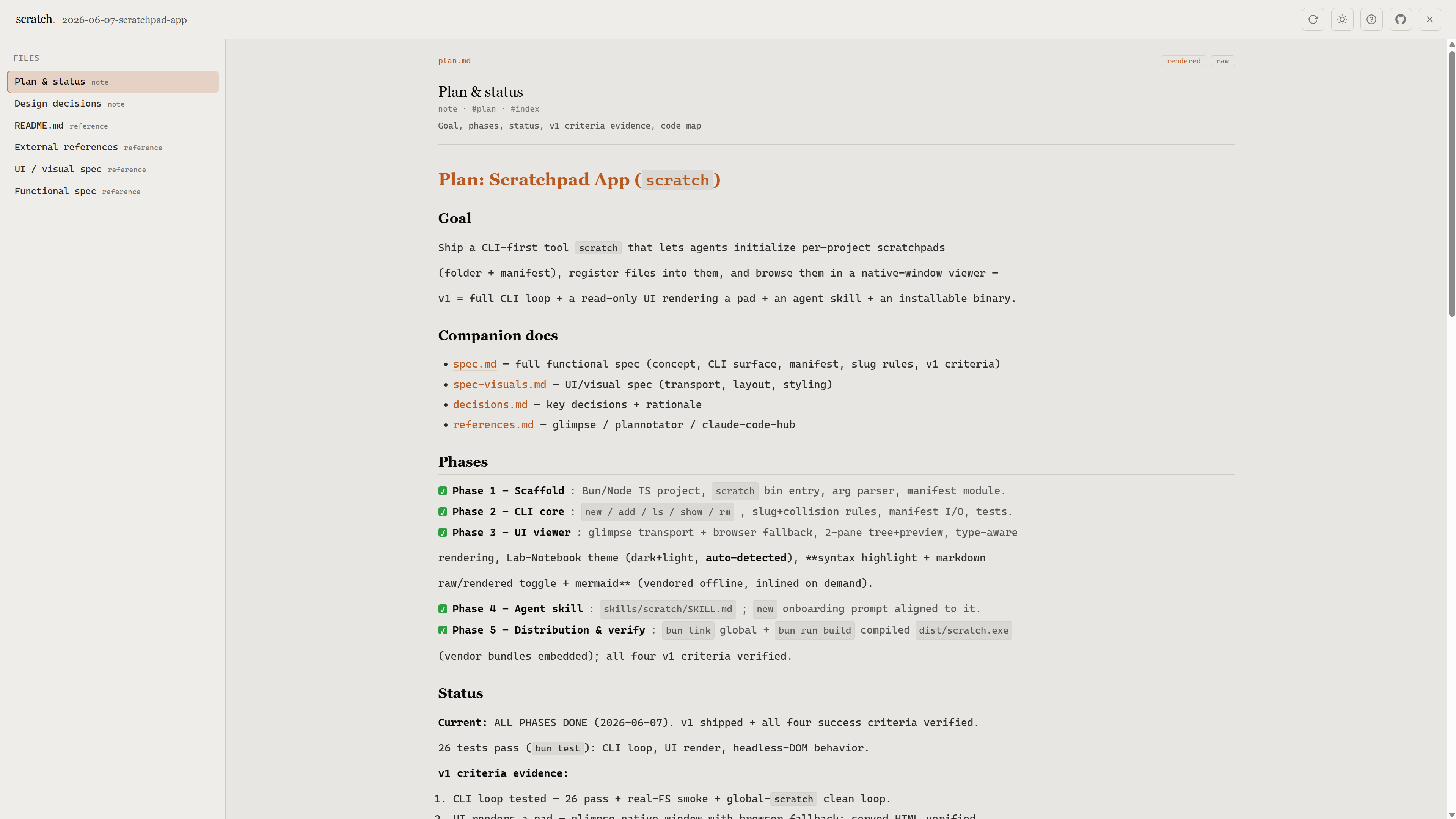
Read-only, 2-pane (pad/file tree + preview) in a "Lab Notebook" theme that auto-detects OS light/dark. Shows all files in the pad dir (unregistered ones dimmed). Per-file preview:
- Markdown rendered, with a raw/rendered toggle.
- Code syntax-highlighted (highlight.js).
- Mermaid diagrams (
```mermaidfenced blocks). - Images inline; binaries / oversized files get a notice.
Transport is glimpse for a native window; if its per-OS backend is unavailable (Windows needs .NET 8 SDK + WebView2), it falls back to serving the same HTML over a local server + the browser.
Config
User-level viewer preferences live in a single JSON file (machine-wide, not per-pad):
// ~/.config/scratchpad/config.json
{
  "ui": {
    "frameless": true   // native window without OS title bar/border (page draws
                        // its own close button + drag strip). Set false for native chrome.
  }
}