原始内容
pi-compact-display
An extension for the Pi Assistant that allows you to finely customize the terminal (TUI) output for various tools (e.g., bash, read, ls, edit) on a per-tool basis.
It helps keep your context and screen clean by limiting overly long tool outputs or hiding unnecessary tool calls, summarizing them instead.
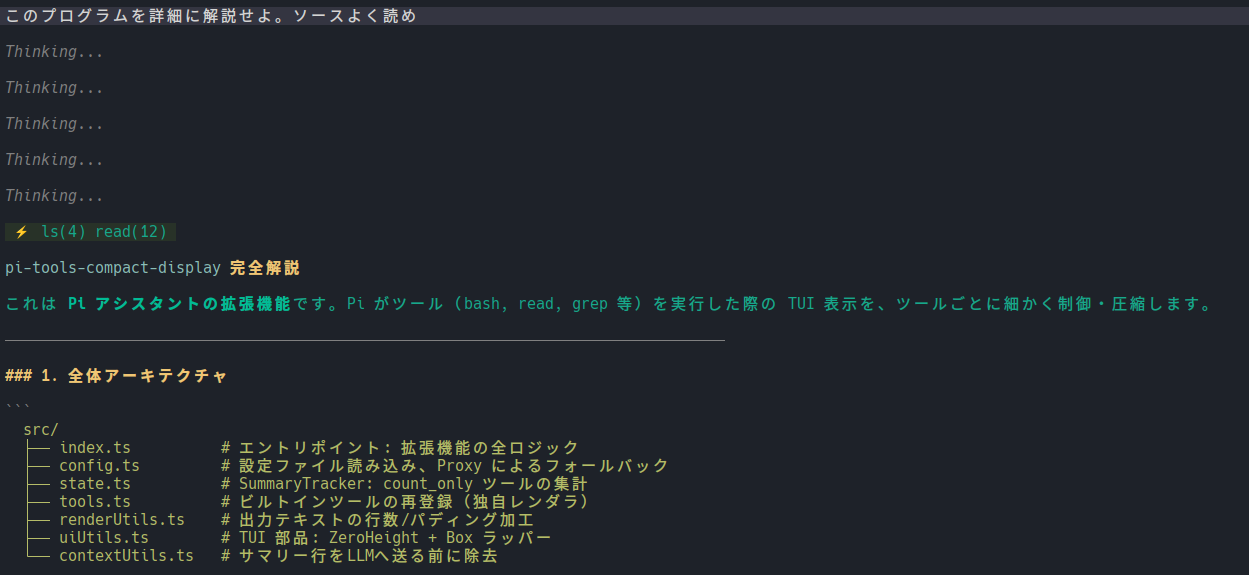
Features
- Per-Tool Configuration: Set different display modes for each tool.
- Summary Display: Hide execution details and output only a summary like
⚡ read(1) ls(2)at the top of the assistant's response. - Line Limit & Padding Removal: Limit the number of output lines and automatically strip empty padding lines.
- Support for External Tools: Override the display settings not only for Pi's built-in tools but also for any custom tools added by other extensions.
- Expandable Details: Fully supports Pi's native expand feature (e.g., pressing
Ctrl+Oin the TUI), overriding the limits to show the full output.
Installation & Build
From npm (Recommended)
You can install the extension directly from npm:
pi install npm:pi-compact-display
From Source (Local Development)
# Clone or navigate to the repository
cd pi-compact-display

# Install dependencies
npm install

# Build the TypeScript code
npm run build

# Install the extension using the Pi CLI
pi install .
Configuration
Create a configuration file named config.json at the following location:
File Path:
~/.pi/agent/extensions/pi-compact-display/config.json
Configuration Structure
The configuration is in JSON format, where the key is the "tool name" and the value is its "display settings (options)".
{
  "tool_name": {
    "mode": "display_mode",
    "outputLines": number,
    "noPadding": true or false
  }
}
Available Properties
| Property | Type | Description |
|---|---|---|
mode |
string |
The display mode for the tool. Must be "count_only", "lines", or "default". (Required) |
outputLines |
number |
The maximum number of lines to display. Only effective when mode is "lines". (Optional) |
noPadding |
boolean |
Whether to remove leading, trailing, and consecutive empty lines from the output. Set to true to omit empty lines. Only effective when mode is "lines". (Optional) |
Display Modes (mode)
"count_only"- Behavior: The tool execution and its output are completely hidden from the screen. Instead, the number of executions is summarized at the top of the assistant's message (e.g.,
⚡ read(1)). - Use Case: Best for tools like
read,ls,find, orgrep, where the LLM gathers information autonomously and humans do not need to read the raw output.
- Behavior: The tool execution and its output are completely hidden from the screen. Instead, the number of executions is summarized at the top of the assistant's message (e.g.,
"lines"- Behavior: Displays the tool execution command and a truncated portion of its result. It limits the output to the specified
outputLines. - Use Case: Ideal for tools like
bash,edit, orwrite, where humans want to quickly check the executed command and whether it resulted in an error.
- Behavior: Displays the tool execution command and a truncated portion of its result. It limits the output to the specified
"default"- Behavior: Bypasses this extension's rendering overrides and falls back to Pi's default rendering logic (or logic defined by other extensions).
- Note: Any tool not specified in the configuration file, or if
config.jsonis missing entirely, will automatically default todefault.
Example Configuration
{
  "user": {
    "noPadding": true
  },
  "read": { "mode": "count_only" },
  "ls": { "mode": "count_only" },
  "find": { "mode": "count_only" },
  "grep": { "mode": "count_only" },

  "bash": {
    "mode": "lines",
    "outputLines": 3,
    "noPadding": true
  },
  "write": {
    "mode": "lines",
    "outputLines": 1,
    "noPadding": true
  },

  "mcp:tavily_tavily_search": { "mode": "count_only" },
  "mcp:list": { "mode": "lines", "outputLines": 10 },
  "mcp": { "mode": "default" },
  "default": { "mode": "count_only" },

  "my_custom_tool": {
    "mode": "count_only"
  }
}
Note: You can specify any tool name, including custom tools added by other extensions like my_custom_tool.
Sub-tool and Action-Specific Configuration (Gateway Tools like MCP)
For "gateway tools" that call other tools or actions internally (such as the mcp tool), you can configure them specifically based on their arguments (like tool or action).
The configuration priority is evaluated in a cascading fallback:
Specific Sub-tool Configuration > General Tool Configuration > default Key Configuration > System Default.
This mechanism applies to all tools, not just MCP.
Example for MCP tools:
mcp:<tool_name>: When a specific MCP tool is called (e.g.,"mcp:tavily_tavily_search": { "mode": "count_only" }).mcp:list: When listing available tools on a server (e.g.,"mcp:list": { "mode": "lines", "outputLines": 10 }).mcp:connect: When connecting to a server.mcp: The general fallback for MCP calls that don't match any specific configuration.
Note: The same priority (specific setting > "default" setting) applies to built-in tools like read and bash as well.
User Prompt Padding Configuration
If you want to remove the vertical empty lines (vertical padding) that appear above and below the prompt messages you enter, you can configure them specifically using the "user" key. This configuration is not affected by other configurations like "default" and is only applied if explicitly defined.
Configuration Example:
{
  "user": {
    "noPadding": true
  }
}
noPadding(boolean): Set totrueto remove the empty lines (padding) inserted above and below your prompt input, making the UI extremely compact.
Usage & Shortcuts
After setting up the configuration, simply start the Pi assistant.
- Context Cleanup: Tools set to
count_onlywill display summaries like⚡ read(1)on the screen. However, this summary text is automatically stripped from the conversation history (context) sent to the LLM behind the scenes, so it won't pollute the LLM's context window. - Full Output (Expanded): If the output is truncated in
linesmode, you can use Pi's native expand shortcut (typicallyCtrl+O) to bypass the line limits and view the full output.