原始内容
pi-extensible-workflows
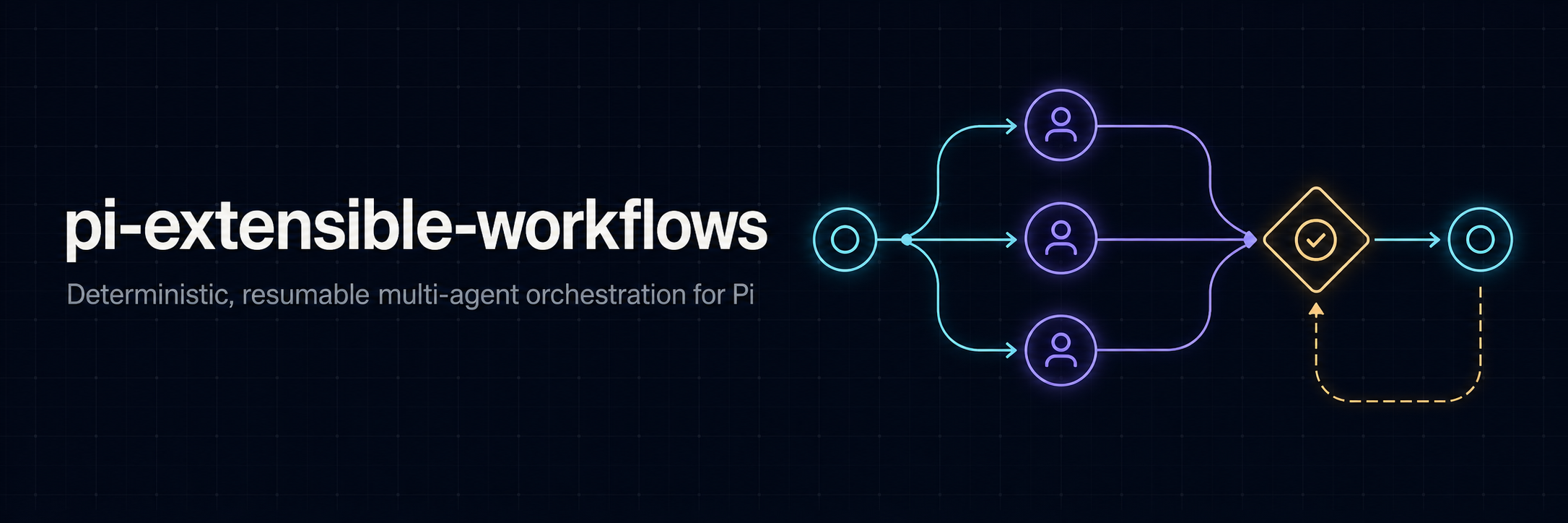
There are many workflow extensions but this one is Yours.
Turn multi-agent tasks into deterministic jobs that fan out in parallel, pause for approval, and resume without rerunning completed work.
Documentation | Developer guide | Agent guide
Requires Node.js 22.19 or newer. This is a trusted Pi extension with the same filesystem and process access as Pi.
Install
pi install npm:pi-extensible-workflows
For source installs and local development, see the installation guide.
Capabilities
The main Pi agent acts as the orchestrator: it writes workflow scripts on the fly for each task. Pi extensions can add reusable functions and variables to those scripts; every registered function is also directly runnable as a top-level workflow.
Inline workflow launches require a non-empty name; registered function launches reject name and use their registered function name as the run name. Workflow worktree scopes always use the explicit withWorktree(name, callback) form.
A workflow can fan out across specialized agents, combine their results, and resume without rerunning completed work.
const reviews = await parallel("review", {
  correctness: () => agent("Review the current changes for correctness issues."),
  security: () => agent("Review the current changes for security risks.", {
    role: "security-specialist",
  }),
  tests: () => agent("Review the current changes for missing test coverage."),
});

const summary = await agent(
  prompt("Deduplicate and prioritize these findings:\n\n{reviews}", { reviews }),
);

return summary;
Learn more about roles, workflow contracts, and extension APIs in the documentation:
- Workflow tool and invocation API
- Global and project settings
- Aggregate run budgets
- Workflow DSL and worktrees
- Reusable extension primitives
- Run artifacts and lifecycle events
- Run inspection and recovery
- Agent patterns and model selection
- Checkpoints
Configuration
Global workflow settings live at ~/.pi/agent/pi-extensible-workflows/settings.json by default and configure concurrency, model aliases, and workflow-agent skill or extension exclusions. Trusted projects can add resource exclusions at <project>/.pi/pi-extensible-workflows/settings.json; they cannot override global aliases or concurrency. See global and project settings for the schema and merge rules.
CLI
npx pi-extensible-workflows doctor
npx pi-extensible-workflows inspect [session-id]
npx pi-extensible-workflows transcript <session-file>
npx pi-extensible-workflows run <workflow-name> [workflow arguments]
npx pi-extensible-workflows export <workflow-name> [--name <command>] [--output <path>] [--force]
doctor validates the installation and active Pi resources. inspect opens a read-only terminal view of persisted workflow runs. transcript renders a session transcript to stdout. run derives flat CLI arguments and help from a registered function's input schema. Use --input '<json>' for nested or otherwise complex inputs. It executes in the current working directory, writes the final JSON result to stdout, and writes progress and errors to stderr. export creates an executable POSIX launcher in ~/.local/bin by default.
run and export accept the trust overrides --approve and --no-approve; the generated launcher forwards its arguments to run. -- ends launcher option parsing, and later tokens are passed to workflow input instead of being interpreted as launcher options.
Launch snapshots use identity version 5. Cold resume rejects older snapshots, including v4 snapshots created with the previous worktree or registered-function naming contracts, with RESUME_INCOMPATIBLE; relaunch the workflow instead.
Development
npm ci
npm run check
npm run acceptance
npm pack --dry-run --json
Model-backed evaluations are optional. See the evaluation guide.
License
MIT