---
slug: "pi-todo-rail"
source_type: "readme"
source_url: "https://cdn.jsdelivr.net/gh/j-joker/pi-todo-rail@main/README.md"
repo: "https://github.com/j-joker/pi-todo-rail"
source_file: "README.md"
branch: "main"
---
# pi-todo-rail
[](https://www.npmjs.com/package/pi-todo-rail)
[](LICENSE)
A Pi extension that turns model output into a persistent, branch-aware Todo list — pinned above the editor, shared between you and the agent.
## The output scrolls away. The plan stays.
A model gives you a code review. Three findings. Clear priorities.
Then the conversation moves on.
One command. One patch. One more answer. The findings are still there—but now you have to go looking for them.
`pi-todo-rail` keeps the plan where the work happens: above the editor, visible to you and Pi.
No scrollback archaeology. No hidden agent checklist. No second source of truth.
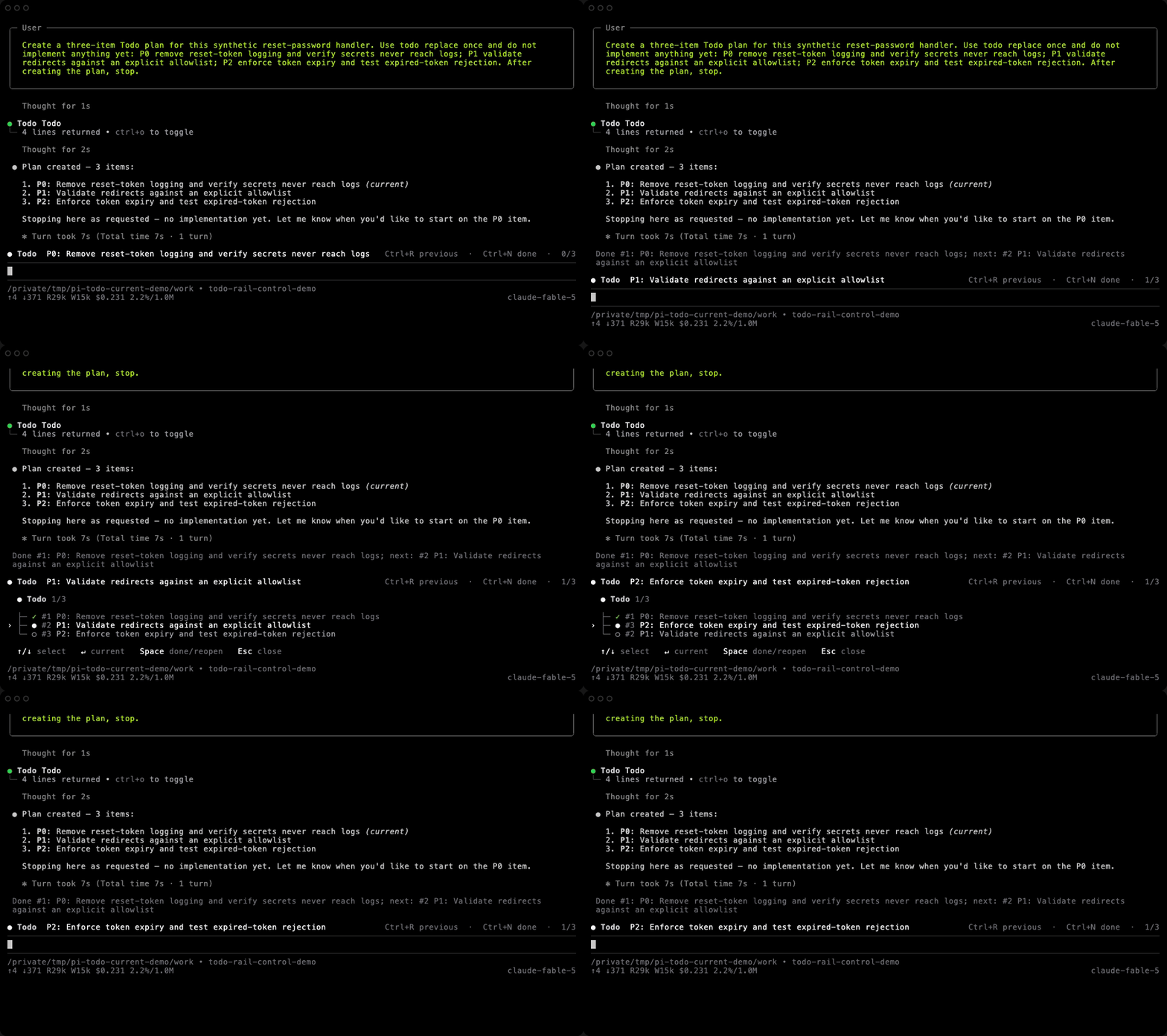
Real Pi config · automatic handoff · human-directed priority
## Install
```bash
pi install npm:pi-todo-rail
```
Or pin the GitHub release:
```bash
pi install git:github.com/j-joker/pi-todo-rail@v0.2.2
```
Try it without installing:
```bash
pi -e npm:pi-todo-rail
```
Requires Pi 0.80+ (Node.js 22.19+ for development).
## Say it once
```text
Break these findings down into Todo tasks.
```
That is enough.
Pi turns the output into a shared plan. The first unfinished task appears above the editor. Progress stays beside it. When the conversation grows, the plan does not move.
```text
MODEL OUTPUT
P0 Reset tokens are logged
P1 Redirect URLs are unvalidated
P2 Reset tokens never expire
↓
TODO RAIL
● Todo Remove reset-token logging 0/3
```
The answer remains evidence. The rail becomes execution.
When granularity matters, add the steps yourself. When the output is already clear, ask Pi to materialize it. Either way, you keep final control.
## One plan. Shared.
```text
MODEL proposes · reviews · explains
YOU choose · split · prioritize · redirect
PI record · execute · verify · advance
SHARED current task · progress · context · branch history
```
Pi sees the same current task you see.
It is instructed to complete work only after implementation **and** verification. You can complete, reopen, reorder, remove, or replace any task at any time.
The first unfinished task is always current. There is no separate active flag to drift out of sync.
## Quiet by default
Most of the time, Todo Rail is one line:
```text
● Todo Remove reset-token logging 0/3
```
Just the next thing that matters. When you want control, run `/todo`:
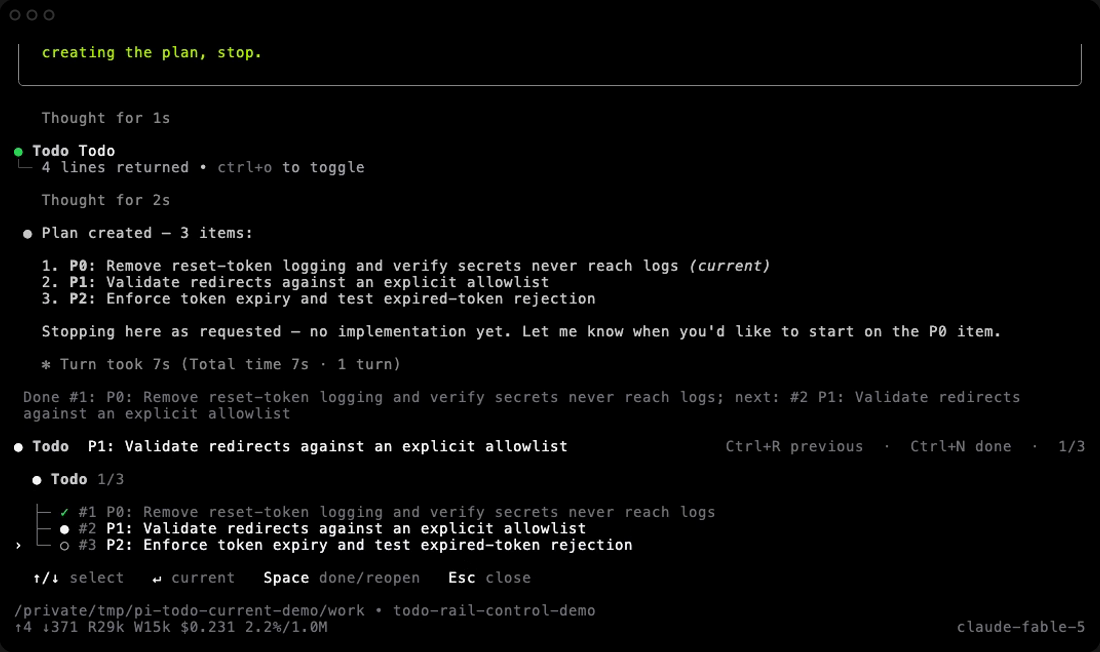
The symbols do the work:
```text
› selected
● current
○ pending
✓ done
› ├─ ● selected + current
└─ ○ pending
```
The selection belongs to you. The current task belongs to the plan.
## Fast path
```text
Ctrl+N Complete the current task
Ctrl+R Return to the previous task
```
The shortcuts wrap Pi’s active editor component. If your terminal already owns either key, use `/todo` instead.
## Commands
```text
/todo Open the panel
/todo add Add a task
/todo list Print the list
/todo done Complete or reopen
/todo rm Remove
/todo clear-done Clear completed tasks
/todo reset Reset after confirmation
```
Pi gets the same plan through a branch-aware `todo` tool:
```text
list · add · update · start · done · block
remove · reorder · clear_done · replace
```
You steer. Pi advances verified work. Both operate on one list.
## The plan follows the conversation
Todo state lives in the Pi session—not in a project file or external database.
Fork a conversation and each branch keeps its own plan. Navigate the tree or resume later and the right Todo list returns with it.
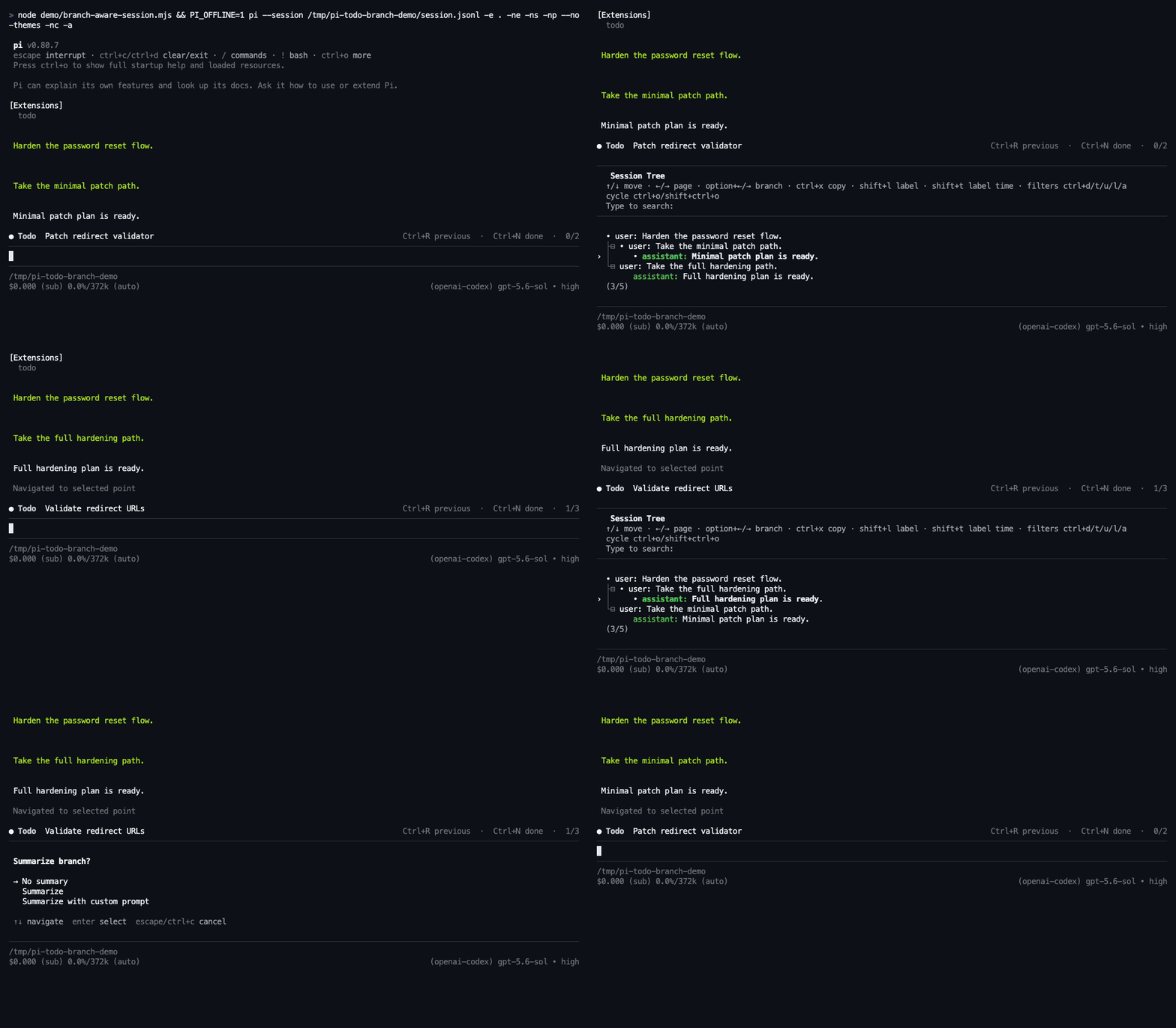
Real Pi TUI · switch branches → restore the matching plan
The rail remembers the decision without pretending the conversation never branched.
## A handoff you can see
When the current task becomes done, the rail shows exactly what changed:
```text
● done task → ✓ done task → ● next task
```
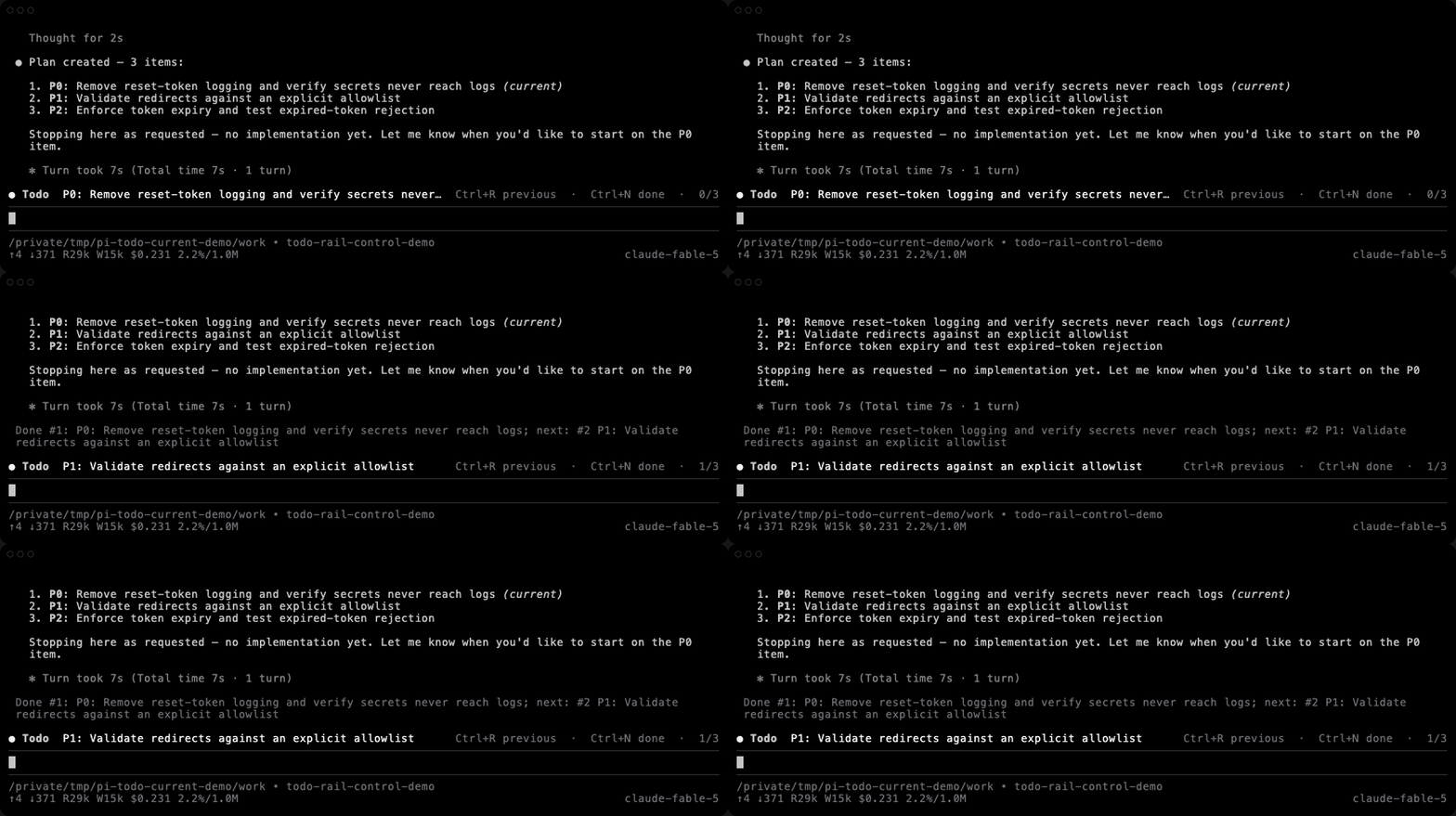
The animation lasts about 200ms. It never blocks input. It only plays when completed work causes a real handoff.
Disable it when needed:
```bash
TODO_MOTION=0 pi
```
Also respected: `REDUCE_MOTION=1`, `PI_REDUCED_MOTION=1`, `CI`, and `TERM=dumb`. Session restore and tree navigation never animate.
How state works
State is stored in structured tool-result details and manual `todo-state` session entries. On restore, the extension reads the latest valid snapshot on the active branch.
No database is created. No project file is written. Todo Rail follows Pi’s session model instead of creating a parallel one.
Development
Requires Node.js 22.19+ and Pi 0.80+.
```bash
git clone https://github.com/j-joker/pi-todo-rail.git
cd pi-todo-rail
npm install
npm test
pi -e .
```
Validate the release tarball:
```bash
npm run pack:check
```
FAQ
**`Ctrl+N` / `Ctrl+R` don’t work.**
Your terminal or another extension probably owns the key. Everything the shortcuts do is also available through `/todo`.
**Where is my Todo list stored?**
In the Pi session itself. No project file, no database. Delete the session and the plan goes with it.
**I resumed a session and see an older plan.**
Each conversation branch keeps its own list. Check which branch you are on — the rail restores the latest snapshot of the *active* branch.
**How do I turn off the handoff animation?**
Start Pi with `TODO_MOTION=0`, or set `REDUCE_MOTION=1` / `PI_REDUCED_MOTION=1`.
## Security
Pi extensions run with the user’s full system permissions. Review extension source before installation.
`pi-todo-rail` does not start network services, spawn subprocesses, or write external state.
## License
MIT — [j-joker/pi-todo-rail](https://github.com/j-joker/pi-todo-rail)